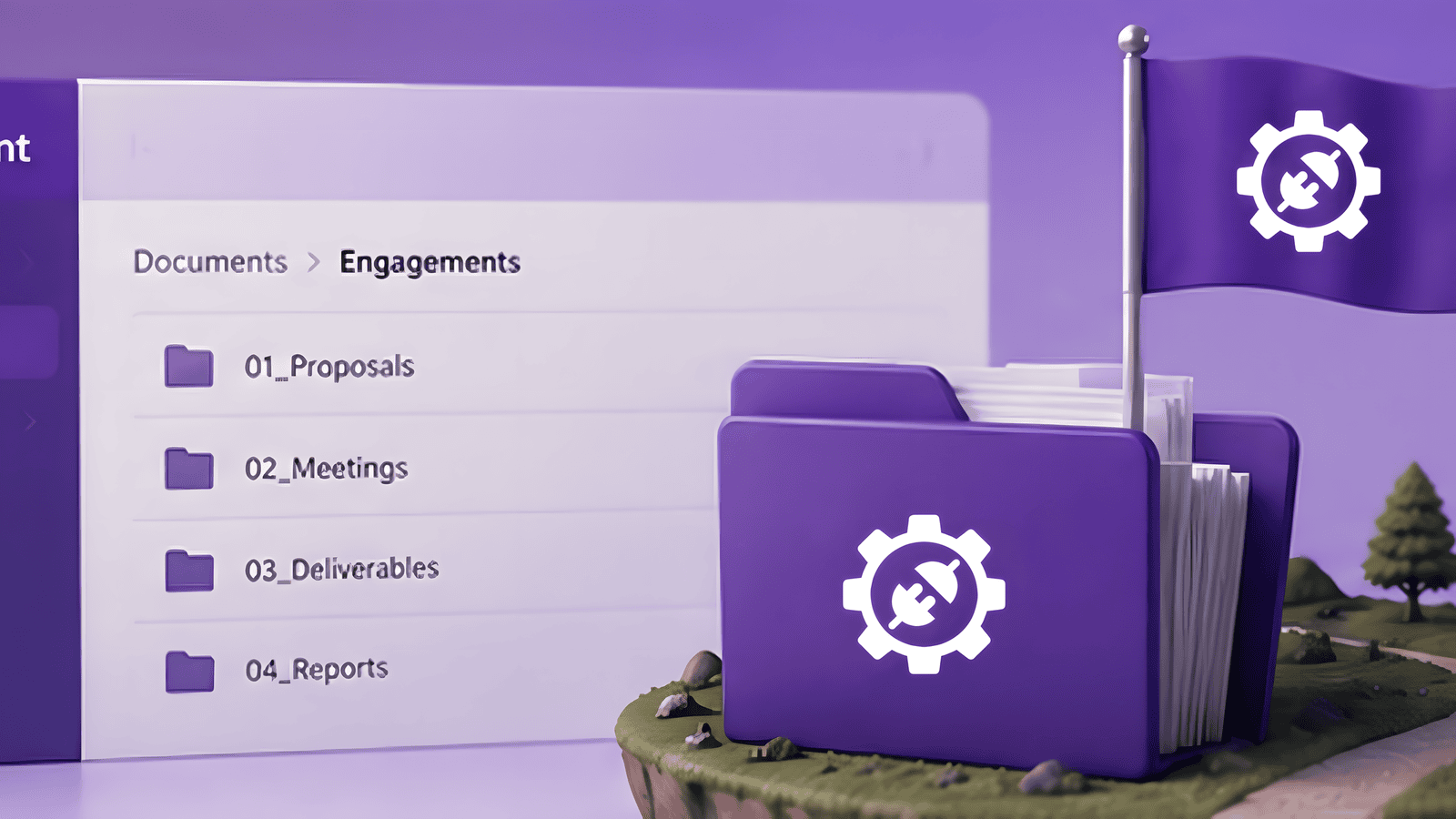
Open your last three project sites side by side. If they are three different shapes, that is not a tidiness problem. It is the reason nothing can be found in the same place twice, and the reason every governance conversation has to be had again on every project.
That inconsistency has a simple origin. Every one of those sites was built by whoever had time that week, structured however they happened to be thinking about the project that morning, with permissions set from memory rather than from a policy anyone wrote down. None of that is negligence. It is what happens when "stand up a project site" has no fixed answer, only a person doing their best against a deadline.
One office's habits become three
Now multiply that by three offices. One office's habit of naming a folder a certain way becomes three different habits, one per office, and none of the three people involved did anything wrong. Each is being reasonably consistent with themselves. The firm is not being consistent with itself, and because nobody individually caused the drift, nobody individually owns fixing it. It just accumulates, one project at a time, until "where do we usually put the meeting minutes" has three correct answers depending on which office you ask.
Careful is not a system
The instinct is to fix this with a memo: a naming convention, a checklist, a line in the kickoff agenda. It does not hold, for the same reason it never holds anywhere else in a firm's document practice. A consistency problem is not solved by asking people to be more careful under deadline pressure. It is solved by making the consistent version the only version anyone can produce. The site has to arrive built. Nobody should be assembling it by hand in the first place, no matter how careful they mean to be.
What actually gets cloned
That is what a golden template means in practice: cloned in full every time a project starts, not handed over as a starting point for somebody to finish. The site is created and joined to the right hub automatically, and the hub navigation updates to point to it. From there the clone runs layer by layer: the same site features, the same permissions, the same content types and site columns, the same list structure, the same library structure, the same navigation, the same default folder content already in place. A Planner board is created alongside it, seeded with the template's own tasks rather than handed over blank. The homepage generates itself, project details already filled in. None of it is a scaffold somebody finishes later. It is the finished site, on day one, the same shape as the last one and the one before that, whichever office opened it.
A project list that stays true
There is a second piece that matters as much as the site itself. The project record that started the whole process, the row in the project registry, links back automatically to the site and the board it just created. That sounds small until you have watched a project list go stale the ordinary way: a project gets added, a site gets built by hand somewhere else, and six months later the two have drifted apart, or the link never gets made at all because making it was one more manual step nobody prioritized. Here the link is not a step somebody has to remember. It is a direct consequence of provisioning, which means the project list stays a true index of where the work actually lives instead of becoming one more record somebody has to reconcile against reality.
What this does not do yet
One limit is worth stating plainly, because a reader who discovers it later stops trusting everything else in this post. The template improves over time. A site provisioned before an improvement lands does not receive it after the fact. There is no drift detection today, and no way to re-apply an updated template to a site that already exists. Every project going forward gets the current template. The ones already built keep the shape they were built with. That is a real gap, not a hidden one, and it is better to know it now than to discover it in a steering meeting.
Get in touch, and we will walk your last three project sites side by side.