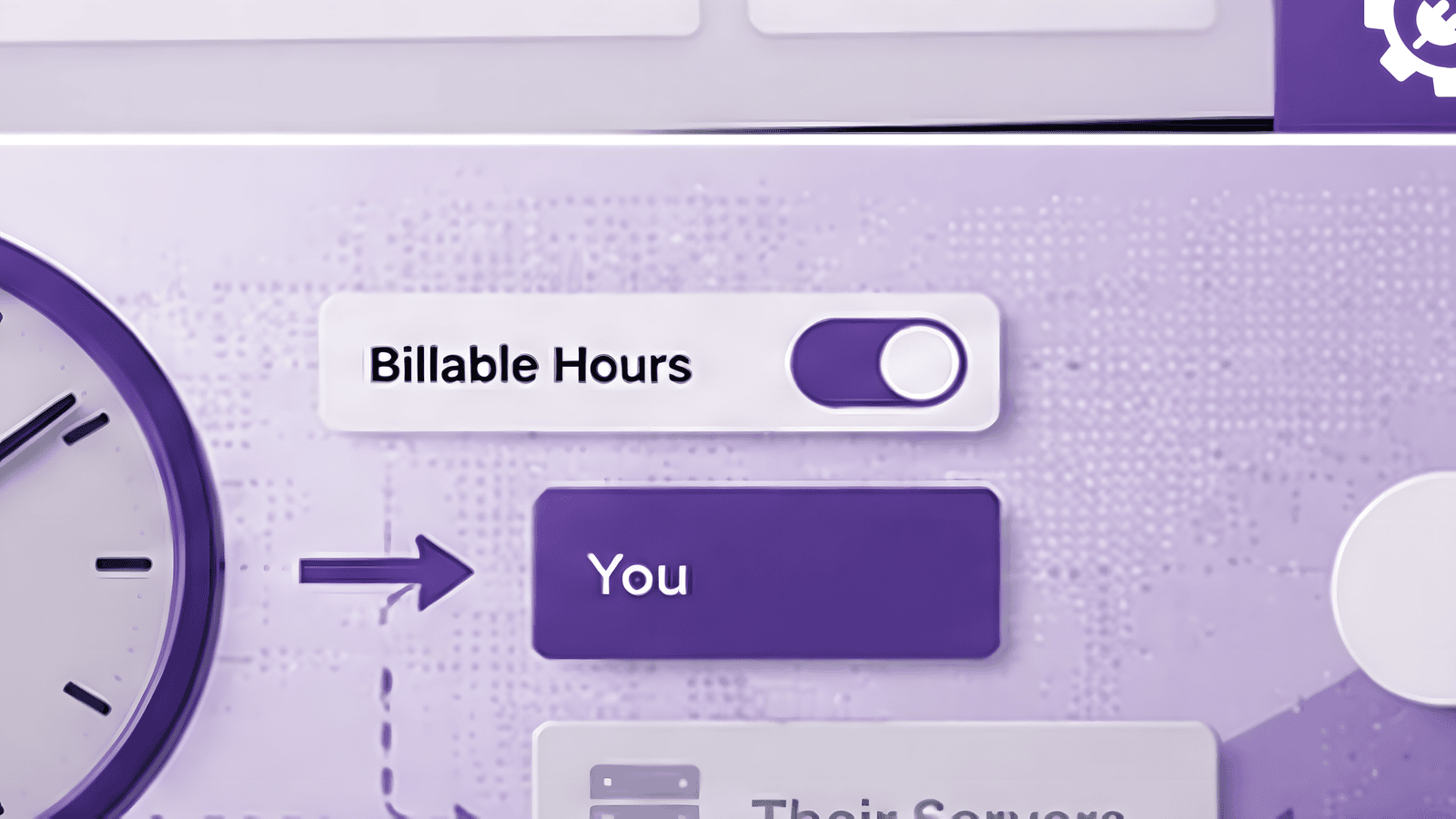
Every hour your team bills starts its life as a row in a time-tracking tool, and for almost every firm we meet, that row lives on a vendor's servers, under a vendor's subscription, in a vendor's data model. The record your invoices, your utilization numbers, and your project decisions all stand on is the one record your organisation does not hold.
That is not because anyone chose it deliberately. It is because the market never offered the alternative. The time-tracking category grew up as hosted software, and hosted is simply what every serious option is. We went looking for a major time-tracking product that genuinely
lives inside a customer's own SharePoint, and we have looked twice now. We have not found one.
A category that all lives somewhere else
Harvest, Ruddr, Clockify, QuickBooks Time: mature products, and every one of them is vendor-hosted, multi-tenant software. Where they meet Microsoft 365 at all, it is through a connector, an API, or a tab pinned inside Teams. The integration goes to where your people
are. The data still goes to where the vendor is.
That arrangement has consequences you only feel later. When the subscription lapses, the history is an export file, in whatever shape the vendor exports. When procurement asks where the data lives, the answer is a trust-centre page. And when the vendor changes hands, the
terms can change with it.
The meter only turns one way
That last one is not hypothetical. Harvest, under new ownership, restructured its pricing from a flat per-seat model to seat plus usage: its own pricing page now says additional invoices, projects, clients, and tasks are billed based on what you use. Ruddr's per-seat model makes non-billable users free only while enough of the workspace stays billable. Clockify's free tier is generous right up until you need the things an organisation needs, and single sign-on, provisioning, and the audit log sit in its top tier.
None of this is scandalous. It is what per-seat software does. But it means the cost of writing down what your own people did grows with your headcount, forever, and the identity and audit features your IT team considers baseline are priced as premiums.
Sign-in you already own
Here is the structural difference with a SharePoint-resident tool. There is no vendor identity system, so there is no single sign-on tier to buy. Your people sign in with the Microsoft 365 account they already have, under the conditional-access and MFA policies your IT team already runs. Single sign-on is free by construction, because there is no second system to connect.
What time entry looks like inside your tenant
ProjectPoint treats time entry as rows in a SharePoint list in your own site, next to the project they belong to. The entry surface is a browser extension that sits in the side panel of Edge or Chrome: start a timer on any tab, or log the time by hand, and the entry is written straight to your list using the sign-in the person already has. There is no Entra app to register, no admin consent to grant, and it never reads cookies. Your data never leaves SharePoint, because it was never anywhere else.
The list is yours. Reporting is your reporting, retention is your retention policy, and if you stop working with us the rows are still sitting in your tenant, readable and exportable, because they are ordinary SharePoint list items.
The honest concession
There is one thing the incumbents do that we will not pretend to match today. Harvest and Ruddr both track time at the task level as entry-level behaviour. ProjectPoint's time entry today is at the project level, with a category. Task and sub-task granularity belongs to the top of our ladder, on Dataverse, and it is not built. If your job to be done this quarter is task-level time against a work-breakdown structure, one of those tools is the honest recommendation, and we would rather you heard that from us.
But if the job is honest hours, against the right project, in a record your organization actually owns, that is exactly the thing nobody else in this category has built.
Get in touch, and we will show you time entry that lives where your projects already do.